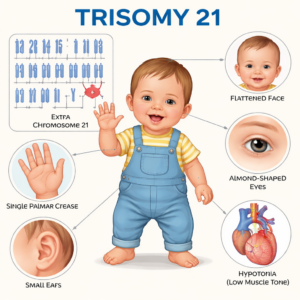
Mosaic Down syndrome is a less common form of Down syndrome in which only some of a person’s cells have an extra copy of chromosome 21. Because the genetic difference is not present in every cell, children with this form may have fewer or less noticeable features than children with the more common form of Down syndrome. However, every child is different, and appearance alone cannot confirm or rule out the condition.
According to the Centers for Disease Control and Prevention (CDC), about 2% of people with Down syndrome have the mosaic form. Overall, approximately 5,775 babies are born with Down syndrome each year in the United States.
For parents, understanding what mosaicism means can make developmental differences, physical signs, and genetic test results easier to discuss with a child’s healthcare team.
What Is Mosaic Down Syndrome?
Mosaic Down syndrome happens when a person has different populations of cells: some cells have the usual two copies of chromosome 21, while other cells have three copies.
The word “mosaic” simply means a mixture. Typically, the genetic change develops because of an error in cell division very early in fetal development. As the cells continue to divide, some carry the extra chromosome while others do not.
This differs from trisomy 21, in which cells typically contain three separate copies of chromosome 21. According to the CDC, trisomy 21 accounts for approximately 95% of Down syndrome, translocation Down syndrome for approximately 3%, and mosaic down syndrome for approximately 2%.
Importantly, having mosaicism does not tell parents exactly how their child will develop. The percentage and distribution of cells with an extra chromosome can vary among different tissues. Therefore, two children with similar genetic test results may still have different strengths, developmental needs, and health concerns.
What Is Mosaic Down Syndrome Symptoms?
Mosaic Down syndrome symptoms can include developmental, physical, and health differences associated with Down syndrome, but their presence and severity vary considerably.
For example, a child may have lower muscle tone, reach certain developmental milestones later, or need additional support with speech and learning. Some children may have fewer or less noticeable features, although development and health needs vary from person to person.
Common features associated with Down syndrome include:
- Low muscle tone, particularly during infancy
- Delays in speech or language development
- Differences or delays in motor development, such as sitting or walking
- Learning differences
- Shorter-than-average height
- Smaller hands and feet
- Loose or flexible joints
Some children can also have health conditions such as congenital heart defects, hearing loss, eye conditions, recurrent ear infections, or obstructive sleep apnea.
However, parents should not assume that a child with the mosaic form will have all, or even most, of these concerns. Likewise, having fewer visible features does not necessarily mean that developmental or medical follow-up is unnecessary.
What Are the Signs of Mosaic Down Syndrome?
Signs of mosaic down syndrome may be subtle, which can sometimes make the condition harder to recognize based on physical examination alone.
A parent might first notice that their baby has low muscle tone or takes longer to develop certain motor skills. In other cases, concerns may emerge later because of speech, learning, growth, or developmental differences.
In one older study examining the accuracy of clinical diagnosis, 37.5% of mosaic down syndrome cases were identified based on clinical features, compared with 90% of trisomy 21 cases.
Therefore, a child who does not have the more recognizable appearance associated with Down syndrome can still have mosaicism.
If a pediatrician or genetic specialist suspects a chromosomal condition, chromosome testing can help establish a diagnosis. In some situations involving mosaicism, clinicians may consider testing more than one type of tissue because mosaicism may not be represented in the same way in every tissue.
What Are Mosaic Down Syndrome Facial Features?
Mosaic Down syndrome facial features can resemble those associated with other forms of Down syndrome, although they may be less noticeable in some children.
Possible facial characteristics associated with Down syndrome include a flatter facial profile, particularly around the bridge of the nose; upward-slanting eyes; small ears; and a shorter neck.
Still, there is no single “Down syndrome face,” and not every child will have the same combination of features.
This distinction is particularly important for parents looking at photographs online and wondering whether their child’s face matches what they see. Many facial characteristics associated with genetic conditions also occur naturally in children who do not have those conditions.
For that reason, facial features should be treated as observations, not a diagnosis. A healthcare professional considers a child’s overall development, medical history, physical examination, and, when appropriate, genetic testing.
Does Mosaic Down Syndrome Mean Symptoms Will Be Mild?
Not necessarily. Mosaicism can sometimes be associated with fewer or milder features, but the term “mosaic” cannot predict an individual child’s abilities or future health.
The CDC notes that people with mosaic down syndrome may have fewer features because some of their cells have the usual two copies of chromosome 21.
However, development is much more complicated than a single percentage on a chromosome report. One study examining cells from different tissues found a relationship between the proportion of trisomic cells and clinical features. However, the effects of mosaicism can be difficult to predict and may vary between individuals.
In everyday life, that means a child’s actual development matters more than assumptions based on the word “mosaic.”
How Is Mosaic Down Syndrome Diagnosed?
A chromosome analysis is used to confirm mosaic down syndrome rather than relying on symptoms or appearance alone.
After birth, chromosome testing may be performed using a blood sample. The laboratory examines chromosomes from multiple cells to determine whether there are different cell populations – some with two copies of chromosome 21 and others with three.
Because mosaicism may vary among tissues, additional testing may occasionally be considered when clinical findings and an initial blood test do not provide a clear explanation.
Parents who receive an unexpected chromosome result can also ask for a referral to a genetic counsellor or medical geneticist. These professionals can explain what the laboratory findings do – and, just as importantly, do not – tell you about your child’s development.
What Should Parents Do If They Notice Possible Signs?
If you are concerned about your child’s development or physical features, start by discussing the specific changes you have noticed with your pediatrician.
Bring concrete observations to the appointment. For example, mention if your baby seems unusually floppy, is having feeding difficulties, is not progressing with expected developmental skills, or if you have concerns about hearing, vision, growth, or communication.
Your pediatrician can review your child’s development and decide whether further evaluation is appropriate. Depending on the findings, this may include developmental assessment, hearing or vision testing, cardiac evaluation, or referral to genetics.
Most importantly, try not to determine whether your child has mosaic down syndrome from facial appearance, developmental milestones, or an online symptom checklist alone. These observations can help start a useful conversation with a healthcare professional, but chromosome testing is needed to establish the chromosomal diagnosis.