For many parents, one of the most exciting and nerve-wracking questions is: When do babies start crawling? Watching your little one move for the first time brings a mix of pride and curiosity. Is it happening on time? Should you be worried if it hasn’t happened yet? We’ll cover when most babies start crawling, how they get there, and what you can do if your child seems to be taking a different path.
When Do Babies Start Crawling, Typically?
Most babies start crawling between 6 and 10 months of age. Some may begin earlier, around 5 months, and others may wait until after 10 months. Like with other developmental milestones, crawling doesn’t happen at the exact same age for every child.
According to the Centers for Disease Control and Prevention (CDC), most babies can sit without support and may begin crawling or scooting by around 9 months of age. But if your baby is a bit late, it’s not necessarily a red flag – some babies skip crawling altogether and go straight to pulling up or walking.
Different Ways Babies Learn to Crawl
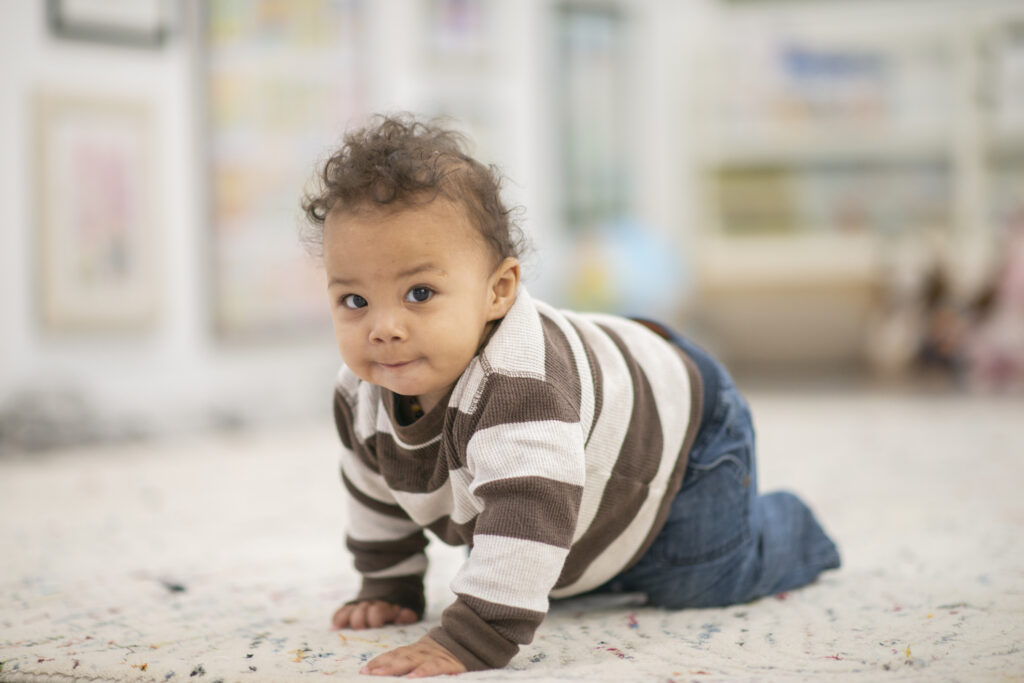
When talking about when do babies start crawling, it’s helpful to know that crawling doesn’t look the same for every child. There are a few common styles:
- Classic crawl: Moving on hands and knees, alternating arms and legs.
- Army crawl: Dragging the belly across the floor while pushing with arms.
- Bear crawl: Moving on hands and feet, with knees off the ground.
- Crab crawl: Pushing backward or sideways, often with one leg tucked.
These are all normal. What matters most is that your baby is finding a way to get from point A to point B using coordinated movement.
How to Support Crawling Development at Home
There are simple ways to encourage your baby to crawl. Tummy time is one of the most important. Starting from birth, give your baby time each day on their tummy while awake and supervised. This helps them build neck, shoulder, and arm strength – all essential for crawling.
By around 4–6 months, babies usually begin pushing up with their arms and rocking back and forth on their hands and knees. You can encourage this by placing toys just out of reach to motivate them to move.
Here are a few tips:
- Use a soft, flat surface for safe crawling.
- Place favorite toys just a little farther than they can reach.
- Get down on the floor and crawl with them – babies love to mimic!
- Avoid overuse of walkers or bouncers, which can delay crawling.
What If My Baby Isn’t Crawling Yet?
If you’re wondering when do babies start crawling because your child hasn’t yet shown signs, try not to panic. Some babies never crawl and still develop normally. What’s important is that your baby is learning to move, explore, and build strength in their own way.
However, if your baby:
- Isn’t rolling over by 6 months
- Can’t sit up without help by 9 months
- Shows no signs of trying to move by 10 months
It’s a good idea to check in with your pediatrician. They may recommend a developmental screening to make sure your baby is on track.
What If My Baby Skipped the Crawling Stage and Is Already Walking
If your baby bypassed crawling and went straight to walking, you’re probably equally amazed and wondering if everything is okay. Take a breath, you’re not alone, and in most cases, there’s nothing to worry about.
Skipping crawling is more common than people think. Some babies scoot, roll, or cruise along furniture and then suddenly pull themselves up and start walking, completely bypassing the hands-and-knees stage. Developmentally, what matters most isn’t how your baby gets moving, but that they’re building strength, coordination, and confidence along the way.
Researchers have noted that crawling supports hand-eye coordination and cross-body brain development, but studies haven’t shown that skipping it causes long-term issues. Many babies who go straight to walking go on to hit every other milestone right on schedule.
That said, here are a few things worth keeping in mind:
- Keep offering floor time. Even if your baby is walking, time spent on all fours reaching for toys helps build core and upper body strength they’ll continue to need.
- Watch the bigger picture. Is your baby babbling, making eye contact, responding to their name, and curious about the world? If yes, those are great signs that development is on track overall.
- Baby-proof for a walker. Your little one is now mobile in a whole new way — make sure low furniture edges, stairs, and sharp corners are covered.
- Mention it at your next check-up. It’s always worth bringing up at your routine visit. Your pediatrician can confirm everything looks good and put your mind at ease.
What the Research Says
Studies show that early motor skills like crawling are connected to cognitive and emotional development. A study published in Developmental Psychology found that crawling babies often become more curious and better at problem-solving.
Crawling also helps babies understand distance, build hand-eye coordination, and strengthen muscles used later for walking, standing, and climbing.
So, when do babies start crawling? Most babies begin somewhere between 6 and 10 months, but the range is wide, and every baby is unique. Crawling is just one part of a larger developmental journey. If your child is healthy and progressing in other areas – smiling, babbling, reaching for toys – they’re probably doing just fine. Keep offering support, encouragement, and floor time. And remember, crawling might be your baby’s first big adventure – but it won’t be their last.