
There are many reasons why a baby does not walk according to set developmental milestones. Generally, babies may start walking anywhere between the ages of 9-15 months, but in some instances, some babies walk earlier, and some babies walk later than this range.
Generally, if a baby is not walking independently by 18 months, further assessment may be needed to understand why there is a delay and an underlying reason for this delay.
Walking is a gross motor skill involving the large muscles of the legs. Usually, in terms of infant development, it will be preceded by rolling over, learning to sit independently, crawling, standing independently, and using furniture or other props for cruising around the room.
Sometimes late walking may follow delay in other areas of an infant’s gross motor development. It may follow crawling late, as one example. It is not uncommon for infants to skip crawling, for example. Still, walking is an essential gross motor skill, and a delay in meeting it is bound to trigger concern in parents and caregivers alike if a child has completed, even if with a slight delay, their other major gross motor milestones there may not be immediate cause for concern when it comes to a late walker.
Signs Your Baby Is Getting Ready to Walk
Walking usually happens in stages rather than all at once. Many babies show clear signs they are getting close to walking independently.
Common signs include:
- pulling up on furniture
- cruising sideways along couches or tables
- standing briefly without support
- taking steps while holding your hands
- squatting and standing back up
- bear crawling on hands and feet
If your baby is cruising confidently, independent walking may only be weeks or months away.
Some of the main reasons for late walking in babies and toddlers are:
- Hereditary: there may be a link between parents who walked later and consequent delay in their own children’s walking. Some infants walk later, and often there are no underlying causes.
- Personality: some infants are in no rush to get walking, and some are more cautious with taking risks needed to master independent walking. They may be content with taking their time and learning developmental steps in their own time. While not measurable as a reason, it is an anecdotal reason for late walking in some infants.
- Environment: babies who may have suffered illness or long-term hospitalization at a young age may not have had the opportunities to move and practice their gross motor skills that aid walking. Infants in environments where they are not given the opportunities to move, play on the floor, and use their developing gross motor skills may also experience a delay in walking. Infants must be given opportunities to move and play and do not spend extended periods in carriers (strollers, baby chairs) that limit their ability to move.
- Prematurity: babies born early may meet all of their developmental milestones slower. Usually, and depending on the extent of prematurity, babies born early should be tracked against the milestones for their due date and not the date they were born.
- A rare disease or genetic syndrome: sometimes a walking delay (combined with other gross motor delays) may be a rare disease sign or symptom. Examples of these include Barth syndrome, Rett syndrome, and Russell-Silver syndrome. If a rare disease is suspected, genetic analysis may be recommended to determine the cause of gross motor delay in a child.
- Underlying health or physical condition: hypotonia (low muscle tone) is a major cause of walking delay in infants. Hypotonia may also present with a rare disease, Williams’ syndrome as one example. Walking delay is also a sign of mild cerebral palsy.
Does Late Walking Mean Something Is Wrong?
One of the most common concerns parents have when their baby is a late walker is whether the delay signals a deeper problem — whether it points to autism, low intelligence, or another developmental condition. Here is what the research and clinical evidence actually shows.
Late Walking and Intelligence
Late walking is not a sign of low intelligence. In fact, research and decades of clinical observation suggest there is no meaningful link between the age a baby starts walking and their cognitive ability or future intellectual development. Many children who walk late go on to be highly capable, curious, and academically strong. The idea that late walkers are less intelligent is a common parental anxiety, but it is not supported by evidence. Equally, there is no strong evidence that late walking is a reliable predictor of above-average intelligence either, despite this being a popular belief in some parenting communities.
Late Walking and Autism
Delayed walking can occasionally be associated with autism spectrum disorder (ASD), but it is important to understand the context. Walking delay alone is not a diagnostic sign of autism. Autism is identified through a pattern of characteristics across social communication, behavior, and sensory processing — not a single motor milestone. That said, if a walking delay occurs alongside other developmental concerns — such as limited eye contact, reduced response to their name, absence of gesturing or pointing, or limited social interaction — it is worth discussing with your pediatrician, who may recommend a broader developmental assessment.
Late Walking and Other Developmental Conditions
In a smaller number of cases, delayed walking may be one sign within a broader pattern of developmental delay. Conditions associated with delayed walking include hypotonia (low muscle tone), cerebral palsy, and certain genetic syndromes. If a walking delay is accompanied by delays in other gross motor skills — such as delayed sitting, reduced muscle tone, or difficulty bearing weight on the legs — this warrants early evaluation. Early identification leads to earlier access to physiotherapy and other support, which can make a meaningful difference.
If your baby is a late walker but is progressing well in other areas — making eye contact, babbling, responding to their name, showing interest in people and objects around them — isolated late walking is much less likely to indicate a significant underlying concern.
Physical Factors That May Influence When a Baby Walks
Beyond the medical and environmental causes outlined above, several physical characteristics can influence when a baby reaches the walking milestone — without indicating anything is wrong.
- Body size and weight: Larger and heavier babies sometimes take a little longer to walk, as they are building the leg strength needed to support a bigger body. This is a normal variation and not a cause for concern on its own.
- Height: Taller babies have a higher center of gravity, which can make balance slightly more challenging in the early stages of walking. Again, this is a normal variation.
- Sex: Some research suggests that, on average, boys may walk slightly later than girls, though the difference is small and well within the range of normal variation.
- Breech birth: Babies born in a breech position sometimes experience mild hip differences that can influence their motor development timeline, including walking. If your baby was born breech and is a late walker, it is worth mentioning to your pediatrician.
- Corrected age in premature babies: Babies born prematurely should be assessed against their corrected age (calculated from their original due date) rather than their birth date. A baby born 8 weeks early who is not walking at 15 months by birth age may be right on track when assessed at their corrected age of 13 months.
When to See Your Pediatrician About Late Walking
While late walking is often a normal variation, there are clear situations where a professional evaluation is recommended. You should speak to your pediatrician or family doctor if:
- Your baby is not walking independently by 18 months — this is the standard AAP and CDC threshold for recommending a developmental evaluation
- Your baby is not standing with support by 12 months
- Your baby loses walking or motor skills they had previously acquired — regression is always a reason to seek prompt assessment
- The walking delay is accompanied by delays in other areas, such as not sitting independently by 9 months, not pulling to stand by 12 months, or significant delays in speech and communication
- You notice reduced muscle tone, floppy limbs, or difficulty bearing weight on the legs
- The delay is accompanied by other signs that concern you, such as limited eye contact, no response to their name, or absent social engagement
Getting an early evaluation does not mean something is definitely wrong. It simply means that a professional can assess your child properly, reassure you where appropriate, and connect you with early intervention services — such as physiotherapy or occupational therapy — if they are needed. Early support, when required, makes a real difference.
How to Help and Encourage Your Baby to Walk
If your baby is a late walker without an identified underlying cause, there are practical things you can do at home to encourage and support their walking development.
- Maximize floor time: Give your baby as much time as possible on the floor, on a safe flat surface, where they can practice pulling up, cruising, and balancing. Limit time in bouncers, swings, and strollers, which restrict movement.
- Encourage barefoot time: Walking barefoot — or in thin-soled, flexible shoes — helps babies feel the ground beneath them and develop the balance and body awareness needed for walking. Avoid stiff or rigid footwear for babies who are learning to walk.
- Use push toys: Sturdy push-along toys (not baby walkers with seats) give babies something to hold on to while they practice taking steps. These are different from traditional baby walkers, which research suggests may actually delay walking by reducing the motivation to walk independently.
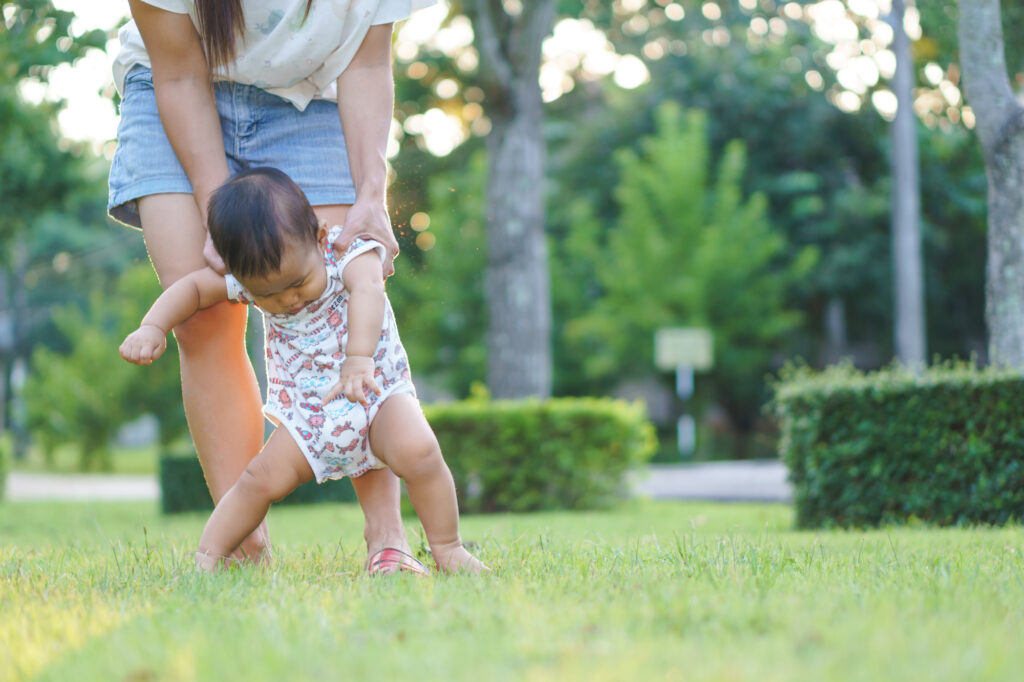
- Offer your hands at the right level: When holding your baby’s hands to practice walking, let them hold at their own shoulder height rather than pulling them up by the arms, which affects their balance and posture.
- Make walking motivating: Place a favourite toy a short distance away on the floor to encourage cruising or first steps toward it.
- Physiotherapy: If your pediatrician has concerns about your baby’s motor development, a referral to a pediatric physiotherapist can provide targeted exercises and hands-on support tailored to your baby’s specific needs.
In most cases, a delay in walking, without delays in any other areas of an infant’s development, does not cause concern. Some infants require more stimulation and encouragement to master the skill for themselves.
If you have any concerns about your child’s development, including their walking skills, or indeed concerns about any of their gross motor skills, the first person to contact is your family doctor. Understanding the reasons behind late walking in babies can help alleviate concerns and guide you in supporting your child’s development.